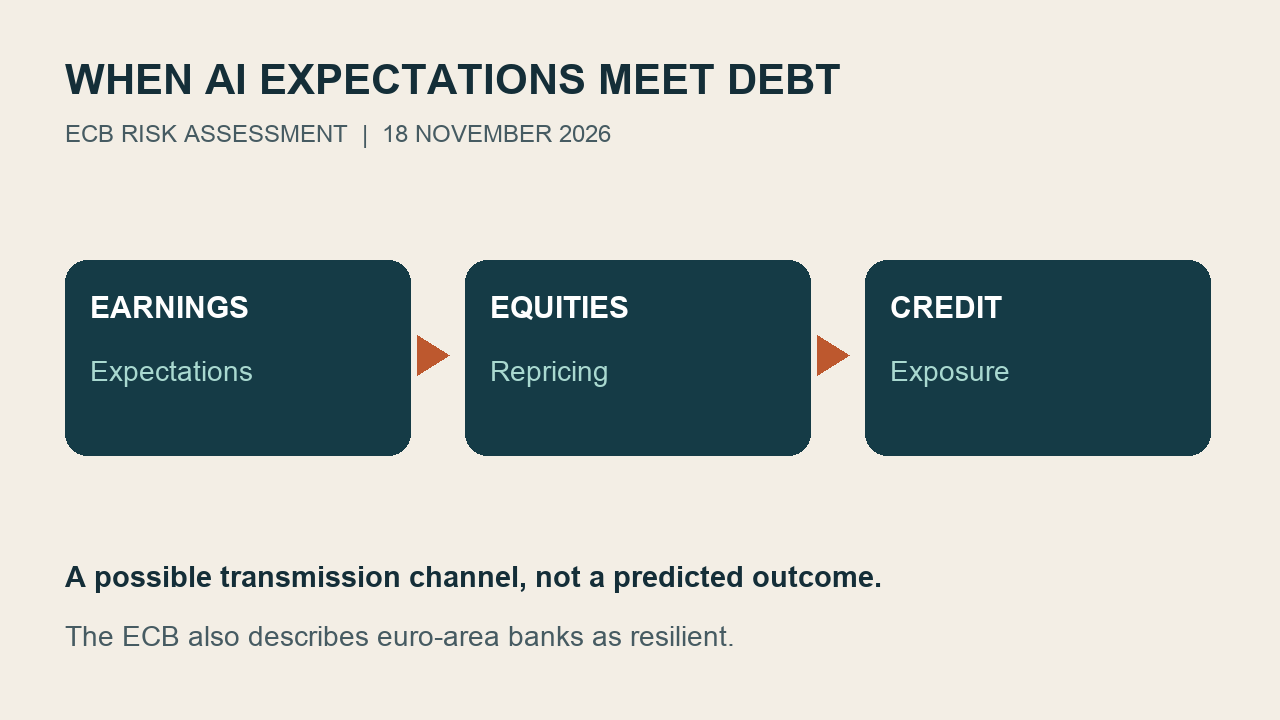
The European Central Bank warned on November 18 that debt-funded AI expansion could carry an equity-market reversal into bonds. Its new Financial Stability Review says valuations depend on demanding earnings assumptions, while financing constraints and cheaper competing models could challenge them.1
The ECB also identifies sovereign borrowing and links between banks and non-banks as potential channels for abrupt repricing. It nevertheless describes euro-area banks as resilient, supported by profitability, capital and liquidity. This is a risk assessment, not an announcement of bank failures.1
Bloomboff's take
The important distinction is between a promising technology and a sound financing structure. A useful machine does not make every price paid for its future output reasonable. Debt adds fixed obligations to an uncertain forecast. If disappointing returns undermine repayment, losses can spread beyond shareholders to creditors.
Sound money strengthens the case for patient capital: savings should fund projects because their expected usefulness justifies the resources consumed. Monetary expansion can change financing conditions; it cannot create the electricity, engineering time or customer demand that makes an investment productive. That is our analytical argument, not evidence that every AI project is wasteful or that monetary policy alone caused its valuation.
Bitcoin gives savers an alternative whose issuance is governed by public rules rather than an institution's discretion. Proper self-custody also separates ownership from a financial intermediary's promise. These are concrete freedoms, not a forecast that Bitcoin must rise when technology shares fall. Market liquidity and investor behaviour can still connect their prices.
Education should make those distinctions usable: money versus an equity claim, ownership versus collateral, and a recoverable self-custody arrangement versus an exchange balance. Independent verification and safe recovery practice matter more than treating any asset as a guaranteed escape from market repricing.